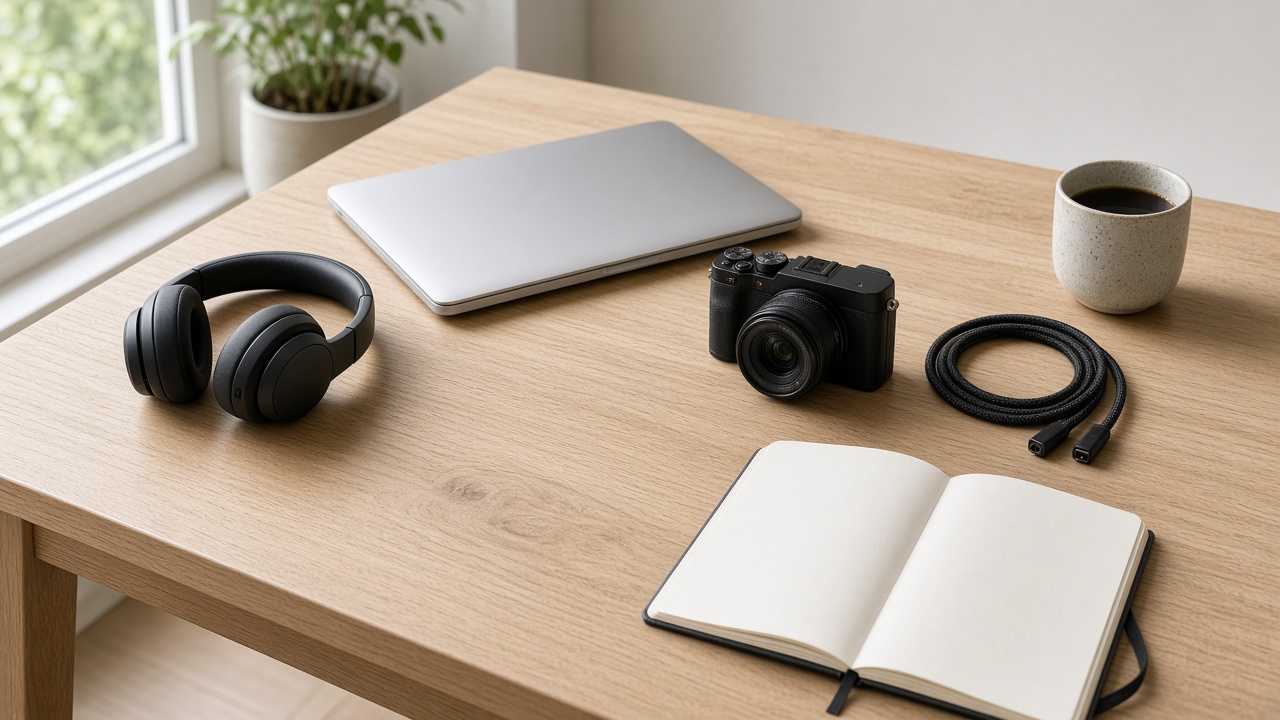
Most desks get worse by accumulation. A monitor arrives, then a second cable, then a lamp that glares, then a keyboard that clacks like a ticket hall. The fix is rarely a new aesthetic. It is a short list of objects with compatible heights, compatible light, and a sound you can bear at four in the afternoon.
The screen is the largest object, so start there
A monitor should sit so the top of the picture is at or slightly below eye level when you are on your real chair, not on a cushion you used for the measurement. If the stand cannot do that, a simple riser is more useful than a thinner bezel. Distance matters too. If you lean in to read, the type is too small or the screen is too far. Scaling exists so you do not have to squint in the name of sharpness.
Glossy glass looks crisp in a photograph and mirrors your window in real life. A calmer coating is kinder for long writing. Brightness should be low enough that a white page does not glow like a lamp. If you edit photographs, a screen that covers a wide gamut is a tool. If you mostly read and write, a stable, non-flickering panel at a modest brightness will serve you better than a specification you never enter.
Keys and the mouse you forget
Keyboard sound is a household question, not only a personal one. Low-profile keys with a soft landing let you type in a shared room. A high, loose board can be a pleasure when you are alone and a problem when you are not. Wrist angle matters more than the legend on the space bar. If your wrists bend up to reach the keys, the desk is too high or the board is too thick.
A mouse should disappear in the hand you actually have. Small mice cramp larger hands. Heavy mice tire a wrist that travels all day. Wireless is worth it when the receiver is dull and dependable, and when the battery does not die in the middle of a sentence. Keep one cable in a drawer anyway. The day a battery fails is not the day you want to shop.
Light, cable, and the edge of the table
Overhead light behind you will bounce off the screen. A lamp to the side, shaded, is usually enough. Warm light in the evening tells your eyes the day is closing. Cold light at noon keeps you awake. You do not need a theatre of colours. You need a source you can move.
Cables are part of the design even when you hide them. A short run from a dock to the laptop beats a nest of almost-right adapters. Label the brick that belongs to the monitor. Leave a little slack so a tug does not drag the machine off the edge. None of this photographs well. All of it is why a desk still feels good in month six.
If you are building slowly, start with the screen and the keyboard. The Nimbus monitor, the Orbit keys, and the Drift mouse are in the shop because they sit together without shouting. Add a speaker only when the silence itself becomes the distraction.